
Article: Who Invented the Bloody Mary? The History of the Cocktail, From Paris to New York

Who Invented the Bloody Mary? The History of the Cocktail, From Paris to New York
Two men claimed they invented the Bloody Mary, and both had a decent case. Fernand "Pete" Petiot was a young bartender at Harry's New York Bar in Paris who later ran the King Cole Bar at the St. Regis in New York. George Jessel was a Broadway comedian and vaudevillian who said he mixed the first one in Palm Beach after an all-night party.
The short version: Jessel's name is tied to the drink first in print, in 1939, as a simple mix of vodka and tomato juice. Petiot is the one who turned it into the seasoned cocktail we drink now, with salt, pepper, cayenne, Worcestershire and lemon. Below are the two competing origin stories, the evidence for each, a timeline covering the history of the Bloody Mary, and Petiot's own recipe.
The Short Answer
- Who invented the Bloody Mary: Fernand Petiot and George Jessel both claimed it. Many cocktail historians credit Jessel with the early vodka and tomato juice version and Petiot with the seasoned recipe.
- Where: Harry's New York Bar in Paris claims 1921. Jessel placed his version in Palm Beach, Florida. The spiced version came together at the St. Regis Hotel in New York.
- When: Somewhere between the early 1920s and the mid 1930s. The name first shows up in print in November 1939.
- First printed recipe: A 1939 bar book listed "George Jessel's Pick-Me-Up." The first printed recipe under the Bloody Mary name came in 1946.
Before the Bloody Mary, Tomato Juice Had to Catch On
The Bloody Mary is a tomato juice drink, and tomato juice wasn't something people drank until the 20th century. Before that, a popular hangover remedy from the 1880s on was the Prairie Oyster: a raw egg with Worcestershire, vinegar or hot sauce, salt and pepper, swallowed in one go.
The usual starting point for tomato juice is 1917, at the French Lick Springs Hotel in southern Indiana. Chef Louis Perrin ran out of oranges at breakfast, squeezed tomatoes instead, and added sugar and a sauce of his own. It caught on with the hotel's guests, many of them businessmen from Chicago.
Canned tomato juice reached American stores in 1928. The timing mattered. Prohibition was still in force, and the "tomato juice cocktail" became a popular non-alcoholic drink: chilled juice seasoned with salt, lemon juice, Tabasco and Worcestershire sauce. That's most of a Bloody Mary already. People added gin or whatever they had on hand, and newspapers noticed. A 1929 newspaper column mentioned equal parts tomato juice and gin as a cocktail of the moment.
So the seasoning came first, as a temperance drink. What was missing was the vodka and the name.
Claim One: Fernand Petiot at Harry's New York Bar in Paris
Harry's New York Bar opened on Thanksgiving Day, 1911, when the American jockey Tod Sloan had a Manhattan bar taken apart, shipped to Paris and rebuilt at 5 Rue Daunou. He hired a Scottish bartender named Harry MacElhone to run it, and MacElhone bought the place in 1923 and put his name on the door. Through the 1920s it was where American expats drank, Ernest Hemingway among them. The Paris cocktail bar also says it's the birthplace of other classic cocktails, including the Sidecar and the French 75.
Petiot was born in Paris in 1900 and started at the bar as a 16-year-old kitchen boy before he moved up to bartender. Petiot claimed, and Harry's still says, that he mixed vodka and tomato juice there in 1921, and the bar celebrated the Bloody Mary's 100th birthday in 2021. Vodka was easy to find in Paris then, brought by Russians who had fled the revolution. Tomato juice is where the story gets shaky.
The problem is the paper trail. MacElhone published a book of the bar's recipes in 1927, and there's no tomato juice and vodka drink in it. Canned tomato juice also wasn't sold commercially until 1928. Petiot could have pressed his own tomatoes, but skeptics point out that nobody wrote down a Bloody Mary at Harry's until decades later.
Claim Two: George Jessel and the 21 Club Crowd
George Jessel told his version for most of his life. In his memoir, The World I Lived In, he put it in Palm Beach in 1927. After an all-night party, a bartender at a restaurant called La Maze handed him a dusty bottle of vodka, which almost nobody in America had seen during Prohibition. Jessel mixed it with tomato juice, Worcestershire sauce and lemon to make it drinkable. A 1963 newspaper account of the same story put the year at 1930, so the details moved around.
What Jessel has is the printed record. In November 1939, Dorothy Kilgallen's Broadway column mentioned a new hangover cure at the 21 Club in New York called a Bloody Mary, made from tomato juice and vodka. On December 2, 1939, Lucius Beebe wrote in the New York Herald Tribune that Jessel's newest pick-me-up was called a Bloody Mary, "half tomato juice, half vodka." That same year, bartender Charlie Conolly's Cotton Club drink book printed "George Jessel's Pick-Me-Up": 2 oz vodka, 6 oz tomato juice, two dashes of Tabasco and the juice of half a lemon.
The 21 Club has its own name in the mix too. Henry Zbikiewicz, a bartender there in the 1930s, is sometimes credited with the first ones, and Jessel was a regular at his bar.
Jessel never let it go. In 1956 he starred in Smirnoff ads that ran in magazines and newspapers, with the line "I think I invented the Bloody Mary." Smirnoff was trying to sell Americans on vodka, and the Bloody Mary was one of the drinks that did it.
Petiot Brings It to the St. Regis, and It Becomes the Red Snapper
Prohibition ended in December 1933. In 1934, Petiot became head bartender at the King Cole Bar in the St. Regis Hotel in New York, under Maxfield Parrish's Old King Cole mural. He eventually ran a staff of 17 bartenders there and stayed until he retired in 1966.
The St. Regis says Petiot made his tomato drink in 1934 for a guest, Prince Serge Obolensky, who wanted the one he'd had in Paris with more spice. The hotel's owner, Vincent Astor, thought "Bloody Mary" was too vulgar for the room, so it went on the menu as the Red Snapper. The new name never caught on with customers, and today a Red Snapper usually means a Bloody Mary made with gin. Crosby Gaige's 1941 cocktail guide printed a Red Snapper recipe, one of the first anywhere.
In a July 18, 1964 interview with The New Yorker, Petiot gave his side. "I initiated the Bloody Mary of today," he said. He gave Jessel credit for the starting point, but said it was only vodka and tomato juice until he got hold of it. Then he walked through his build: salt, black pepper, cayenne, Worcestershire and lemon, shaken with vodka and thick tomato juice. He said the hotel made 100 to 150 a day.
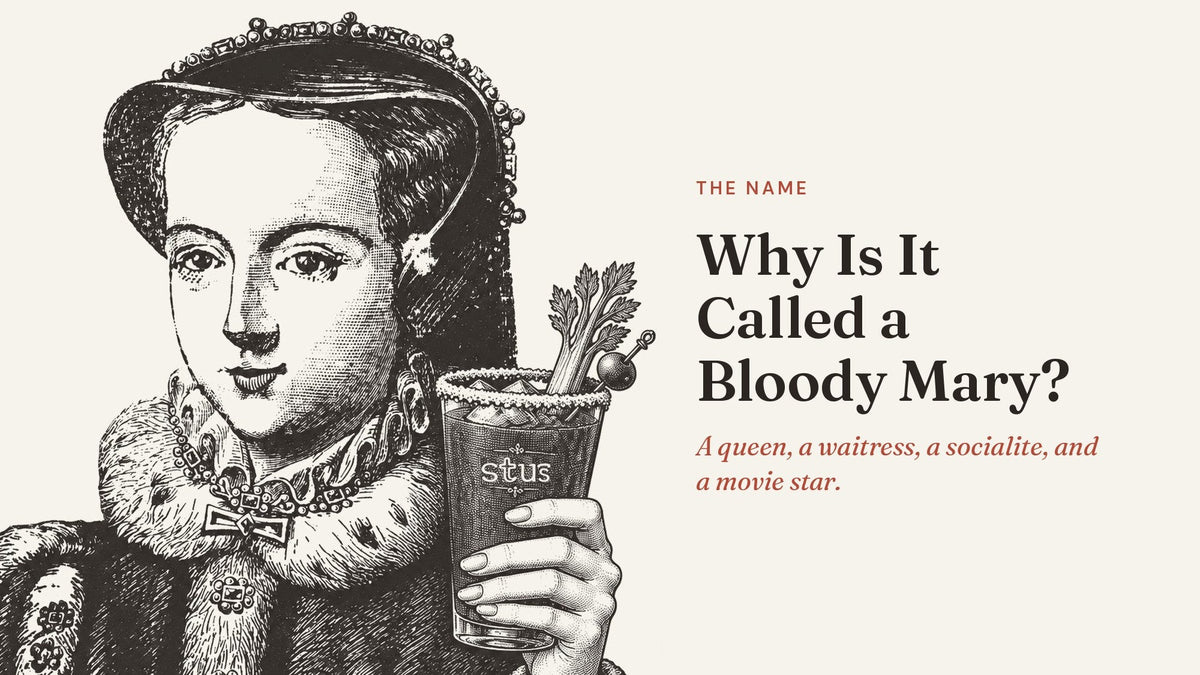
Petiot told one more version in 1972, three years before he died in Canton, Ohio. He said his first Bloody Mary customers in Paris were from Chicago, and one of them named the drink after a waitress named Mary at a bar called the Bucket of Blood. We dig into the story behind the name, and every other theory, in why it's called a Bloody Mary.
So Who Really Invented the Bloody Mary?
Our read: nobody invented the whole thing at once.
The seasoning came from the tomato juice cocktail of the late 1920s, which already had the salty, savory Worcestershire, plus lemon, Tabasco and salt. Vodka and tomato juice together show up in print by the mid 1930s, and cocktail historian David Wondrich points to a 1936 mention, three years before anyone called it a Bloody Mary. The name shows up in 1939, attached to Jessel and the 21 Club crowd. And the seasoned recipe that bars still use looks a lot like the one Petiot described at the St. Regis.
If you need one answer, Jessel gets credit for the early drink and probably the name, and Petiot gets credit for the cocktail. That's also where Brian Bartels, author of the book The Bloody Mary, lands. Harry's 1921 claim may be true, but it's the hardest one to prove.
Bloody Mary History Timeline
| Year | What happened |
|---|---|
| 1911 | Tod Sloan opens the New York Bar in Paris on Thanksgiving Day. |
| 1917 | Chef Louis Perrin serves tomato juice at the French Lick Springs Hotel in Indiana. |
| 1921 | The year Harry's New York Bar gives for Petiot's first vodka and tomato juice. |
| 1923 | Harry MacElhone buys the bar and renames it Harry's New York Bar. |
| 1927 | Jessel's date for his Palm Beach version. MacElhone's recipe book has no Bloody Mary. |
| 1928 | Canned tomato juice goes on sale. The seasoned "tomato juice cocktail" takes off. |
| 1934 | Petiot takes over the King Cole Bar at the St. Regis. The drink goes on the menu as the Red Snapper. |
| 1939 | The Bloody Mary name appears in print, tied to the 21 Club and George Jessel. |
| 1941 | Crosby Gaige prints a Red Snapper. Hemingway later claimed he brought the drink to Hong Kong this year. |
| 1946 | Lucius Beebe's Stork Club Bar Book prints a Bloody Mary recipe. |
| 1956 | Smirnoff ads feature Jessel claiming the drink. |
| 1964 | Petiot tells The New Yorker he made the modern Bloody Mary. |
The Original Bloody Mary Recipe
This is Petiot's St. Regis build as he described it in 1964, the oldest Bloody Mary cocktail recipe we have in either inventor's own words. He started with the seasoning, then added two ounces of vodka and two of tomato juice.
Ingredients (1 drink):
- 2 oz vodka
- 2 oz thick tomato juice
- 4 dashes salt
- 2 dashes black pepper
- 2 dashes cayenne pepper
- About 1/2 tsp Worcestershire sauce (Petiot said "a layer")
- A dash of lemon juice
- Cracked ice
Directions:
- Put the salt, black pepper and cayenne in the bottom of a shaker and cover them with the Worcestershire.
- Add the lemon juice and cracked ice, then the vodka and tomato juice.
- Shake, strain into a chilled glass, and serve.
It's a short, strong drink, half vodka and half tomato juice with no ice in the glass, no celery and no horseradish. Those came later. A modern Bloody Mary is longer and lighter, usually 1.5 oz of vodka to 4 or 5 oz of juice over ice. Good tomato juice still makes the biggest difference. See our picks for the best tomato juice for a Bloody Mary, or make your own.
The Same Drink With Stu's
Petiot's shaker build is mostly measuring. Stu's Classic Bloody Mary Seasoning already has the salt, black pepper, Worcestershire and cayenne heat (from two different hot sauces), plus pickle brine and celery salt.
- 1.5 oz vodka
- 1 oz Stu's Classic
- 4 to 5 oz tomato juice
- Squeeze of lemon, if you like it
Build it over ice and stir. Pour a little less Stu's for mild, a little more for bold. For Petiot's version, shake 2 oz vodka, 2 oz tomato juice and 1/2 oz Stu's with ice and strain it up. Our Worcestershire contains anchovy.

Skip the Dashes
Stu's is Worcestershire, pickle brine, celery salt, and a balanced spice blend in one bottle. One ounce plus 4 to 5 oz of tomato juice, and one bottle makes 16 to 24 drinks. Pour a little less for mild, a little more for bold, no doctoring afterward.
Get Stu's Classic | $15How the Bloody Mary Became a Brunch Staple
From the start, the Bloody Mary was sold as a morning drink. Kilgallen's 1939 column called it a hangover cure, and Beebe called it a pick-me-up. The idea is hair of the dog: a little alcohol the morning after, with salt, spice and tomato to make it go down.
Ernest Hemingway helped. In a 1947 letter to his friend Bernard Peyton, he wrote out his recipe for a pitcher (he said "any smaller amount is worthless"): a pint of vodka, the same amount of chilled tomato juice, Worcestershire, lime juice, celery salt, cayenne and black pepper. Our Bloody Mary pitcher recipe is a little gentler on the vodka.
Smirnoff's ads helped too, as vodka finally caught on in America in the 1950s. Over the next few decades the drink picked up celery stalks, horseradish, pickles and olives, and eventually whole skewers of bacon and shrimp. It also spun off a family of variations: the Bloody Caesar with clam juice, the Bloody Maria with tequila, the Mezcal Bloody Mary, the Bullshot with beef broth, and the Virgin Mary with no alcohol at all. Our Bloody Mary guide covers more than two dozen of them, and our guide to Bloody Mary garnishes covers what goes on top.
Bloody Mary History FAQ
Who invented the Bloody Mary?
Fernand Petiot, a bartender at Harry's New York Bar in Paris and later the St. Regis in New York, and George Jessel, an American comedian, both claimed it. Jessel is tied to the earliest vodka and tomato juice version in print. Petiot created the seasoned recipe most bars still use.
Where did the Bloody Mary originate?
Harry's New York Bar in Paris says the Bloody Mary was invented there in 1921. Jessel said Palm Beach, Florida. The seasoned version we drink today took shape at the King Cole Bar in the St. Regis Hotel in New York in 1934.
When was the Bloody Mary invented?
Between 1921 and 1934, depending on whose story you believe. The name first appeared in print in November 1939.
Is the Bloody Mary originally from England?
No. The drink came out of Paris and New York. The name may nod to Queen Mary I of England, but no evidence connects her to the cocktail. More in why is it called a Bloody Mary.
Was the first Bloody Mary made with vodka or gin?
Vodka, in both Petiot's and Jessel's accounts. Some stories say Petiot switched to gin in New York because vodka was hard to find after Prohibition, and the gin version is now called a Red Snapper.
Is there alcohol in a Bloody Mary?
Yes. A standard Bloody Mary has 1.5 oz of vodka, about one standard drink. Without the vodka, it's a Virgin Mary, sometimes called a Bloody Shame.
Why do people drink Bloody Marys in the morning?
It was pitched as a hangover cure from the very first mention in 1939. Tomato juice reads as breakfast, the salt and spice wake you up, and a little vodka is the old hair-of-the-dog idea. That's how it became the brunch drink.
Want to make one the way they did at the St. Regis? Start with our Bloody Mary guide or set up a Bloody Mary bar and let everyone pick their own spice level.

Leave a comment
This site is protected by hCaptcha and the hCaptcha Privacy Policy and Terms of Service apply.