

How to Make Vodka
How to Make Vodka
⚠️ Disclaimer This guide is for educational purposes only. In the United States and many other countries, distilling spirits at home is illegal without the proper permits. Please research and follow all local laws before attempting any activity described here. Stu's Kitchen does not encourage or endorse unlawful behavior and is not responsible for how this information is used. ⚠️
So, you've mastered the art of the Bloody Mary. You know your way around celery salt rims, your garnish game is strong, and you've got Stu's on lock. But maybe, just maybe, you're ready to take it one step further. Ready to open your own distillery.
Our friends at WikiHow have provided an excellent resource for teaching us how to make vodka, which is why we've condensed it and provided it here for you.
This guide on how to make vodka is designed to provide you with some basic tips on creating your commercial batch. And when it's up and running, you can eventually start experimenting with creativity, such as Bacon Infused Vodka.

How to Make Vodka: Choosing Ingredients
Vodka is commonly made from wheat, rye, barley, corn, or potatoes. Sugar and molasses can also be used alone or added to other ingredients. Whatever you choose, it must have sugars or starches so that alcohol is ultimately produced.
Feel free to introduce ingredients to change and enhance the flavor of your vodka. Yeast eats sugars or starches and spits out alcohol and carbon dioxide.
When making vodka from grains and potatoes, a mash must be made that contains active enzymes that break down the starches from the grains or potatoes and makes fermentable sugars.
Fruit juice already contains sugars so starch-degrading enzymes are not needed. As with fruit juice, vodka made from store-bought sugars need only be fermented, thus bypassing the need for a mash.
When already fermented mediums such as wine are used, the medium can be distilled right away into vodka.
Depending on your mash ingredients, decide whether you need to use additional enzymes.
Food-grade amylase enzyme powder can be purchased from a homebrew shop and added to the mash to convert the starch into fermentable sugars, if you're using something like potatoes, for example. Use the recommended amount of starch to be broken down. There is no need to use malted, enzyme-rich grains such as malted barley or wheat when using enzyme powder.
For enzymes to be able to break down starches, even the starches of malted, enzyme-rich grain, the starches must first be gelatinized.
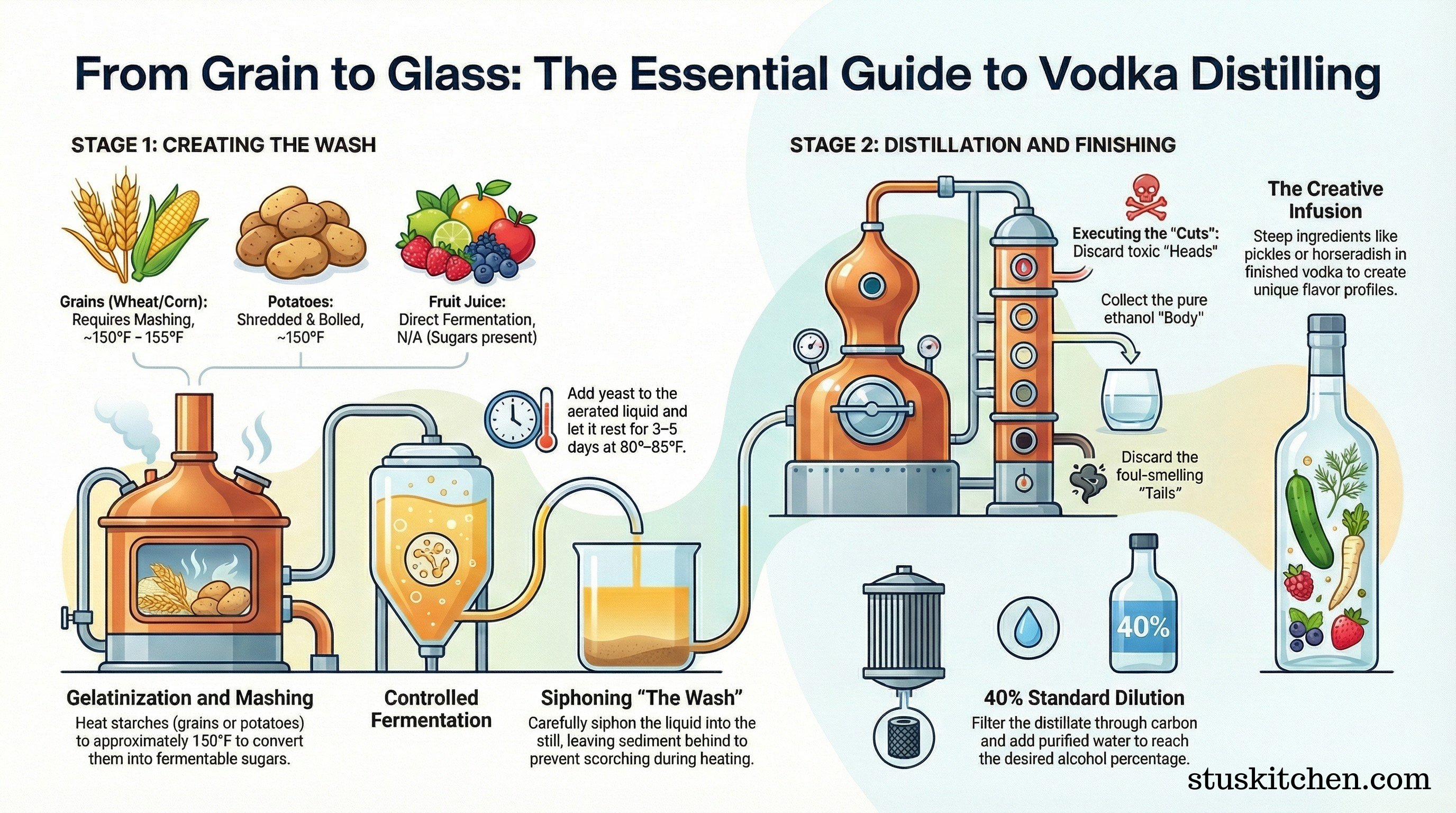
Flaked (rolled) grains are often already gelatinized. Un-gelatinized ingredients such as potatoes and unrolled or malted grains are heated in water to the gelatinization temperature of the particular starch that is used. Potatoes usually gelatinize at approximately 150°F (66 °C), while barley and wheat gelatinize at a similar temperature. Theoretically a potato mash should only need to be heated to 150° F (66° C), anything over 165° will destroy all the enzymes. When using a low temperature with potatoes, they should be finely shredded before adding them to the water.
How to Make Vodka - Different Mashes

Try a wheat mash. In a 10 gallon (38 l) metal pot with lid, heat 6 gallons (23 l) of water to about 165° F (74° C). Add two gallons of dry, flaked wheat and stir. Check the temperature and ensure that it is between 150° F (66° C) and 155° F (68° C). Stir in one gallon of crushed wheat malt. The temperature should be about 149° F (65°). Cover and let rest for 90 minutes to two hours, stirring occasionally. The starches should convert into fermentable sugars during this time, and the mixture should become much less viscous. After 90 minutes to two hours, cool the mixture to 80° – 85° F (27° – 29° C). Use an immersion chiller for rapid cooling or just let it cool overnight, but don't let it get much below 80F.
Try a potato mash. Clean 20 pounds of potatoes. Without peeling, boil them in a large kettle until gelatinized, about one hour. Discard the water and thoroughly mash the potatoes by hand or with a food processor. Return the mashed potatoes to the kettle and add five to six gallons of tap water. Mix to blend and bring mixture to just over 150° F (66° C). Add two pounds of crushed, malted barley or wheat and stir well. Cover and stir periodically over the course of two hours. Let cool overnight to 80° – 85° F (27° – 29° C). Letting it cool for a long period of time also gives the barley malt enzymes more time to break down the potato starch.
Try a corn mash. Make a mash according to the wheat mash recipe, but substitute flaked, pre-gelatinized corn (maize) for the flaked wheat. Alternatively, sprout corn over the course of three days and make a mash from it without added malted grain. A root about two inches long should sprout from each grain. The sprouted corn will contain enzymes that were formed during the germination (sprouting) process.
Clean all your utensils and prepare the area properly.
Fermenting is the Next Step

Fermenting is the next step when learning how to make vodka. Fermentation is conducted in clean, sanitized vessels that are sometimes open but often sealed to prevent air contamination. Fermentation usually lasts for three to five days. It can be done in unsanitary vessels, but is not recommended.
Oxidative cleaners such as 'B-Brite' are available at homebrew shops, as are sanitizers such as iodophor.
Choose and set up your airlock. An airlock is a mechanism that allows CO2 to escape without letting O2 get in. Five-gallon batches of strained mash can be fermented in a 7.5-gallon food-grade bucket or in 6-gallon carboys.
Lids can be affixed to buckets, as can drilled rubber stoppers to carboys, but when using a lid or a stopper, never seal the vessel completely, as pressure from carbon dioxide production will create explosive pressure. Therefore, affix an airlock to lids and drilled rubber stoppers. If possible, avoid fermentation in an open bucket.
Strain the mash or liquid into your fermentation vessel. If a mash was made, strain the liquid with a fine mesh strainer from the mash into your cleaned and sanitized fermentation vessel. Try to splash the liquid and pour it from a distance so that it is well aerated. Yeast initially requires air (oxygen) to grow and initiate a quality fermentation.
Alternatively, ferment the mash without straining. However, the fermented mash should still be aerated in some manner, possibly with an aquarium air pump and an aeration stone. The mash will also need to be strained before it is added to the still, and it may be more convenient to ferment the smaller volume that results from a strained mash, as the fermenting mash may overflow the vessel.
If juice is to be fermented, aerate by pouring from a height through a sieve or strainer into the fermentation vessel.
Add yeast to the fermentable medium. Hydrate the appropriate amount of dried distillers or other desired yeast and add it to the liquid. Stir with a clean, sanitized spoon to evenly disperse the yeast.
If using an airlock, the airlock will bubble during active fermentation, and the bubbling will slow dramatically or cease altogether as the liquid becomes entirely fermented. Keep the fermenting liquid in a room with a temperature of about 80°-85°F to facilitate good, efficient fermentation. Alternatively, use a heating belt in cold areas.
Distillers' yeast will ferment cleanly, producing a high amount of alcohol (ethanol) and relatively low amounts of unwanted compounds, such as alcohols other than ethanol. The amount of yeast used will depend on the specific brand or type of yeast used.
Nutrients may be included with the yeast in the yeast packet. Yeast nutrients are needed when fermenting a medium that is low in nutrients, such as sugar solutions, but they can also improve fermentations when used with nutrient-rich mediums such as those made from grains.
Collect the fermented liquid, also called "the wash." Siphon off the fermented, alcoholic liquid, or 'wash' into a cleaned and sanitized vessel or into the distillation apparatus. Leave the yeast sediment behind in the fermentation vessel, as it can scorch when heated in the still.
Column Flute Stills are a bit more complex than pot stills and are ideal for distilling an odorless, flavorless and higher proof spirit such as vodka. They can be purchased or, depending on the still design, built using readily available materials.
However, column stills and pot stills work in a relatively similar manner:
Cooling water is usually circulated through a sealed compartment in the distillation column, causing the vaporized alcohol and other substances to condense in the column. This means that such a still must be attached directly to a faucet or a mechanical pump to move water from a supply into the still.
If not using recirculating water from a single supply, thousands of gallons of water may be required to produce a small batch of vodka. If water is recirculated from a central reservoir using a pump, approximately fifty gallons of water can be used; however, the water will heat up and become less effective.
How to Make Vodka: Pot Still

Simple pot stills are akin to pressure cookers that are attached to piping or tubing.
They can be constructed very easily and cheaply. Unlike column stills that are essentially vertical columns, pot stills may utilize bent or coiled tubing or piping that can be submerged in a vessel of cooling water. Pumps and large volumes of cooling water are not required but can be used.
Stills heat the fermented, relatively-low alcoholic wash to a temperature that is greater than the boiling point of alcohol, yet less than the boiling point of water. In this way, the alcohol vaporizes while the bulk of the water does not. The vaporized alcohol (along with some vaporized water) travels up into the column, pipe, or tube of the still. External cooling in the form of cold water is applied to the column, pipe or tubing, causing the vaporized alcohol to cool and condense back into liquid.
This alcoholic liquid is collected and becomes vodka.
Heat the wash in the still to begin the distillation process. Depending on the type of still being used, options include gas burners, wood fires, or electric hot plates. A temperature of about 173° F (78.3° C) at sea level is desirable, but the temperature must be kept below the boiling point of water, 212° F (100° C) at sea level. As the wash becomes heated, alcohol and other substances vaporize and condense in the water-cooled area of the still.
Throw out the heads. The first distilled liquid, 'the heads,' that is recovered from the still will be rich in harmful methanol and other volatile chemicals that you don't want to drink. For 5 gallons (19 l) of wash, discard at least the first 2 ounces (60 ml) of distillate.
Collect the body. After you discard the heads, the collected distillate will contain the desired alcohol (ethanol), along with some water and other compounds. This is called the "body". During this time, if using a column still with flowing cold water, the water flow can be adjusted to control the distillate output and purity. Try to shoot for two or three teaspoons of distillate per minute. Increased distillate output results in a decrease in purity.
Throw out the tails. Towards the end of the distillation process, when the temperature creeps up to 212° F (100° C) and beyond, the distillation process produces other nasty chemicals. These are called the "tails," which contain fusel alcohols. The tails are undesirable and should be discarded.
Check the alcohol content and purity of the distillate. Cool a sample of the distillate to 68° F (20° C) and use a hydrometer to measure the percentage of alcohol of the distillate. The distillate may be too dilute to serve as acceptable vodka (weaker than 40 percent alcohol), or may be more concentrated than desired (perhaps higher than 50 percent alcohol). Vodka is usually diluted before bottling, so the distillate may have a very high alcohol content. The distillate may also be too flavorful and aromatic and require additional distillations or carbon filtering.
Filtering and Bottling
Treat with a carbon filter if necessary. Pass the distillate through a carbon filter, such as those available at homebrewing shops, to remove unwanted volatile flavors and aromas. Carbon water filters can also be modified to purify the distillate.
Dilute the vodka to the desired strength. Add purified water to the distillate to attain the desired alcohol percentage. Use a hydrometer to measure the alcohol percentage.
Bottle the vodka. Fill bottles using a gravity bottle filler setup and cork or cap the bottles. Label the bottles with custom labels if desired. Some gravity fillers may consist of a 7.5 gallon (29 L) bottling bucket (with spigot), vinyl tubing, and a simple spring-loaded plastic bottle filler. Multiple-spout wine bottle fillers can also be used.
Infusing Your Vodka

We can't leave out the infusion part in our How To Make Vodka guide. It's the fun part, where you can let your creativity shine.
Once the vodka is made, many consider infusing it with different things to give each batch a different flavor. Maybe you enjoy peach vodka, or apple, or orange. Regardless of your preference, people can infuse their new batch with any flavor they desire. Anything can be infused and we mean that quite literally. If you enjoy a particular flavor, you can likely infuse your vodka with it. For Bloody Marys, we recommend you try pickles, horseradish, peppers, or bacon. Any combination will yield a good-tasting result. For a full breakdown of infusion methods and ideas, check out our guide to the best infused vodka recipes.
For fruits, use about three pieces per batch. Wash all dirty ingredients before moving forward. It will enhance the taste of your vodka and ensure it remains as clear as possible. Put your ingredients into an airtight jar and fill it with vodka. Shake the bottle once a day to keep the process moving along. Then, strain the vodka into a different jar or bottle and you have your finished product!
This guide on how to make vodka provides the essential tips that commercial distillers use. What it doesn't do is consider their creativity. People can make their own creation! Add some unique ingredients that could change the game. If you want to use it in a Bloody Mary, for example, you could throw a pickle or two in there and give it that sour taste. However you want to do it, make sure you do it your way.
Making commercial vodka isn't just a science project; it's an experience. A story. A flex. It's what separates the mixer from the mixologist. And once you've got that crystal-clear batch in hand, don't stop there. Infuse it. Elevate it. Make it taste like brunch, like fire, like whatever you want it to be. Try horseradish or pickled jalapeños for your next Bloody Mary. Or infuse with peach for something totally unexpected. Whatever you do, remember:
When it goes into a Bloody Mary, especially one made with Stu's concentrate, it's not just a cocktail. It's a damn statement.
Looking for the perfect vodka for your next Bloody Mary? Check out our guide to the best vodka for Bloody Marys, or explore more in our Bloody Mary & Savory Drinks guide.
Leave a comment
This site is protected by hCaptcha and the hCaptcha Privacy Policy and Terms of Service apply.